DANCE AND SPIRITUALITY

Zambia

The Republic of Zambia is a landlocked country taking its name from the Zambezi River. Due to a complex history of immigration, it is home to numerous ethnic groups, the largest being the Bemba, Tonga, and Chewa. This diversity is also reflected in the more than 25 different languages that are spoken in the regions of Zambia. 

Zambia has always been a trading nation, especially known for its large iron, high-grade ore, and ivory exports. During the late 19th century, the country was colonized by the British and given the name “Northern Rhodesia” in reference to the mining baron Cecil Rhodes, who played a key part in the struggle to extend British influence in the territory. Northern Rhodesia’s reliance on the mining industry made it a quite unstable country, undergoing many large miners’ strikes during the 20th century. The country was also severely affected by both world wars. It finally gained its independence and was officially renamed Zambia in 1964.

Zambia has a very rich culture, reflecting the diversity of its people. Both dance and theater play an important role in Zambian society. Performance art was always used in a spiritual context, accompanying people through all stages of life. But oftentimes, it was also a tool to express political messages. Dances such as the Mbeni had an important role in acts of protest against oppressive regimes and colonial exploitation. Solidarity is an important part of Zambian culture, which is reflected in a lot of traditional dances that express a strong sense of community. A lot of the dances that became popular during and after Zambia’s fight for independence are practiced by people of many different ethnic groups, consolidating Zambia’s national identity.

Source 1 Wikipedia 

Source 2 Wikipedia

Source Britannica 

Source Archives 

List Of Dances

Chitelele Zambia

*Gule Wamkulu  Mozambique, Malawi, Zambia, Zimbabwe
*Mooba Zambia
Vimbuza   Malawi, Zambia

*Mangwengwe Zambia

Mbeni Zambia

*Kalela Zambia

Ndendeule Zambia

Ngoni Zambia

Nyakasanga Zambia

Muchoma Zambia

Ngoni Zambia


Mooba

Crédit photo: © Victor Makashi, Department of Arts and Culture, Zambia, 2017

Mooba is the main dance of the Lenje ethnic group of Central Province of Zambia,
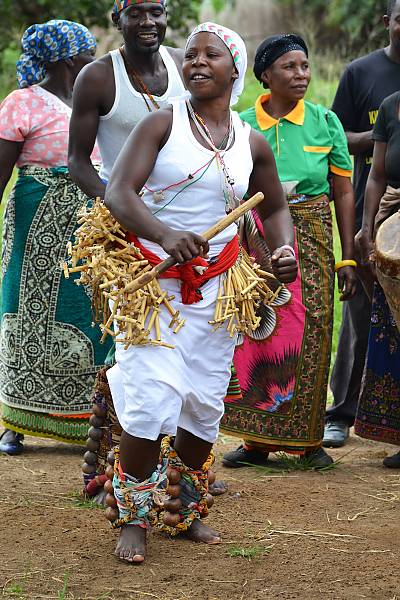
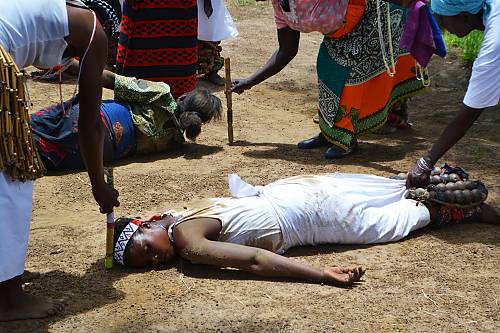
performed since pre-colonial times. It is also practised in parts of Copperbelt and Lusaka Provinces,by both men and women. On certain occasions, when the dance reaches its peak, some lead dancers are possessed by ancestral spirits called BaChooba; it is said that, at this point, the spirits take the lead in dictating the flow of the dance, drumming and singing. Both male and female dancers can be
possessed with BaChooba spirits.

The costume includes coloured beads, a traditional skirt called a Buyombo, and rattles worn around the calves. In addition, the main dancers hold a spiritual stick known as a Chimika and a fly whisk made out of an animal’s tail. Mooba serves both  entertainment and healing functions, and contributes to the spiritual identity of the community. Since the elementis performed during social functions that are open to the public, children can observe and learn it freely, with performances attracting a wide audience thanks to their entertaining nature. Almost
every adult knows the Mooba dance as it is the main dance of the Lenje people. The Lenje community has also established groups that perform wherever they are invited, helping to promotethe practice further afield.


Inscribed in 2018 on the Representative List of the Intangible Cultural Heritage of Humanity of UNESCO,
See Video

Crédit: © Ministry of Tourism and Arts, Zambia, 2017


References
       UNESCO: Read

ZAMBIA

Region:
Central Province

Ethnic group:

Lenje


Mangwengwe

Inscribed in 2024 (19.COM) on the Representative List of the Intangible Cultural Heritage of Humanity

References
       UNESCO: Read

The Mangwengwe is a traditional dance that is performed by the Mambwe and Namwanga people of Zambia. Dating to pre-colonial times, it is characterized by circular movements of the shoulders and sometimes waist. The performance involves a lead singer or dancer, supporting singers and dancers, hand-clappers and musicians. The rhythm is set by the rubbing of wooden stools against the bottoms of clay pots. Most of the singing, dancing and clapping is performed by women, with men occasionally participating on special occasions. Practitioners compose their own songs, which generally describe everyday life, the land, leaders, and current events. The Mangwengwe dance is reserved for important events such as weddings, funerals and traditional ceremonies. Notably, it is the only dance performed at the funeral and burial of a chief. It is also featured in political gatherings to praise or critique political and civic leaders and to communicate their challenges and successes.

ZAMBIA

Spirituality:
traditional

Ethnic group:

Mambwe
Namwanga


Chitelele

The Chitelele is a dance famous in many parts of Zambia. It is danced exclusively by women and is used to welcome important visitors. However, it is also danced during festivities and for entertainment. 

This Chitelele has a particularly communal spirit: the dancers gather in a circle and perform in groups of two or three while the others sing and clap their hands. Depending on the communities, the music may or may not incorporate drums. The song describes the way the Chitelele is performed and incorporates call and response motives, which resemble the ones found in traditional children’s games.

The dance itself involves fast and precise footwork and large hip movements. However, it also allows for a lot of improvisation and personal expression. The dance has a very communal spirit and is popular among younger people. Chitelele music has also been a big inspiration for musicians such as James Chamanyazi, who incorporates some of its elements in his songs.

ZAMBIA

Region: various regions of rural Zambia and Malawi

Ethnic Group: various ones (not a lot of information available)

Countries: Zambia, parts of Malawi 


Mbeni

The Mbeni was a dance popular originating from Nyasaland and popular among communities in former Northern Rhodesia (now Zambia) between the First and Second World Wars. It was a dance invented by World War One veterans, which reflects their experience in this brutal conflict.

There existed different Mbeni dance troupes, with a clearly defined structure that evokes military grades. The highest-graded performer was referred to as the “governor.” One rank below him was the major general, then the lieutenant general, the colonel, the lieutenant colonel, the captain, the lieutenants, the non-commissioned officers, and lastly the soldiers. In case of a conflict within the dance group, a person with the higher rank would be called to resolve the issue. The performers also roleplayed as other professions, such as combat-nurses.

These fictional ranks have an important role in the Mbeni dance. The dance evokes military drills, combat scenarios, and porterage work and turns them into a choreography that one can find amusing. For instance, the dance troupes would form a line in order of their rank, with other dancers circling around them.

The music was played on drums and accentuated by a whistle.

The costumes of the dancers also played an important role. They would have a well-groomed appearance and wear military uniforms along with combat medals and insignias (both real and fake). The different ranks of the dancers were reflected in these costumes.

The Mbeni held political significance: it was a way to critique and make fun of the colonizers who subjugated these communities. On the other hand, it allowed people to learn about and process the horrors of World War. Mbeni dance groups were especially widespread in the mining communities of the Copperbelt region and played an important role in a series of strikes in 1935, during which the Mbeni songs were sung during protests. A lot of dance groups were forbidden under colonial rule because they were suspected to play a part in the organization of anti-colonial movements across southern Africa. Over the years, the Mbeni dance has slowly morphed into different other dances, such as the Kalela (see article about the Kalela for further information), that still exist to this day.

ZAMBIA

Ethnic group: Bemba, Bisa and others 

Region: Nyasaland 

Country: Nyasaland protectorate, Northern Rhodesia (today Malawi, Zambia, Zimbabwe) 

Note: this dance is not to be confused with the Mbeni dance in Kenya


Ndendeule

The Ndendeule is a dance performed by young Chewa girls to celebrate their passing into adulthood. The name derives from the word Ndola, meaning puberty.

 Once a girl menstruates for the first time, she tells her grandmother, who will tell a high-ranked member of the community called a Phungu. He then prepares the initiation process into adulthood for the young girl. To ensure a transition into a successful marriage, she is kept in a hut for about six months, where she learns how to take care of her husband and is educated about her menstrual cycle and sexual intercourse.

After this time, young Ndendeule are welcomed into adulthood and are ready to be married. To celebrate this, they dance in groups of two or three, wearing the same traditional attire. The dance involves a lot of hip movements, sometimes while on the floor, which purposefully resemble those in sexual intercourse. The men of the community also make an appearance. Oftentimes, they will go on all fours, and the young women will dance on their backs. At times, there are also very acrobatic positions being performed, involving up to three people.

The music incorporates drums and singing. The Ndendeule is an event where the community gathers and participates.

The dance has also made its way into other countries. Nowadays, it is often danced outside of this custom for entertainment purposes. 

ZAMBIA

Region: Eastern Province of Zambia

Ethnic Group: Chewa

Countries: Zambia and parts of Malawi  


Kalela

The Kalela originates from the Bangweulu wetlands of Zambia. It appeared during the 1950s, during the country’s colonial era, which is crucial to keep in mind while discussing its themes. Today, it is danced by communities in the regions of Luapula, Copperbelt and the Northern Provinces, in rural and urban areas alike. It is particularly widespread in mining towns. 

The dance is performed in many different contexts, be it festivities, funerals, harvest ceremonies, weddings or entertainment at the chief’s palace. 

The many Kalela dance groups are composed of around 20 people and often organize competitions between each other. All these groups all have the same clearly defined structure. They are led by a king, who is often older than the others and elected by the members of the group. He takes care of the organization and administrative tasks and acts as the treasurer, managing the financial contributions which the members must pay every month. The group also has a leader, who is in charge of creating the choreographies and chants. He also leads the group during performances, whereas the king plays a more discrete role. 

The dancers perform in two or three separate rows, advancing forwards and backwards. The dance also incorporates large hip movements and precise footwork. The performers sometimes mimic certain actions of everyday life, such as picking up the phone. This sometimes involves the use of accessories such as mirrors or handkerchiefs. 

The costumes of the dancers play a central part in the Kalela. Surprisingly, the dancers don’t wear traditional costumes, but western clothing such as T-Shirts, trainers or even suits. Moreover, dancers often play certain roles, such as a nurse or fireman. This phenomenon of imitating western aesthetics can be traced back to the Mbeni dance (for further information, consult the article on the Mbeni dance). On the other hand, the musicians often wear traditional colorful costumes.  

The music of the Kalela is played on two big drums and one small drum. The sounds played on these drums are very loud and can be heard throughout the area, which attracts more spectators. A whistle used by the group leader also plays an important role, giving structure to the rhythms and sending signals to the performers. However, it is without a doubt the chants which are at the center of this music. They are sung in many languages of the three regions. The content of these chants refers to current events in the community, transmitting important moral values to the audience or informing the leaders of the community on the needs of the population. Thus, the Kalela is an important tool to communicate between inhabitants of different social groups. The lyrics allow a certain form of auto celebration, in which the performers refer to their good appearance and values. In these cases, the Kalela can also help someone to find a partner! This auto-celebration can also extend to the entire community: lyrics often praise the culture and the leader of a certain village or region. 

The use of western aesthetics on the one hand and the lyrics celebrating local cultures of Zambia on the other makes the Kalela a particularly fascinating dance. Its popularity in many different communities of northern Zambia allow it to not be specific to one single ethnic group, but to be a representation of broader Zambian culture. In 2022, it was added to the UNESCO representative list of the intangible cultural heritage of humanity.

ZAMBIA

Ethnic groups: Bemba, Aushi, Bissa, and many others 

Regions: Luapula, Copperbelt, Northern Provinces

Countries: Zambia, parts of Zimbabwe


Nyakasanga

The Nyakasanga is a dance popular in the North-Western province of Zambia. Originally, it was performed to celebrate the coming of age of young boys who had just accomplished the Mukanda ceremony.

The Mukanda ceremony is very lengthy and difficult. Young boys are taught to hunt and fish, as well as other practical skills. They are also expected to wear beautiful clothes, which can be a financial burden for their families. Another important part of the ceremony is the circumcision of the initiates. The Nyakasanga is a dance to celebrate this event, seen as an important step towards manhood. It is important to note that the dance is not performed by the young initiates themselves, because they are still in isolation to recover from the procedure, but instead by other members of the community.

The Nyakasanga is a circle dance performed by men and women alike. Because it is also an event allowing people to find a partner, there are often the same number of female and male dancers. The characteristics of the dance vary from community to community: some wear matching vibrant costumes, and others dress in formal attire. It is a very dynamic dance with an emphasis on large arm movements. Most of the Nyakasanga is performed in a circle formation, in which the dancers show a large variety of moves. However, in some instances the circle is momentarily dissolved and the performers dance in pairs. The music of the Nyakasanga consists of drums, singing, and hand clapping and sometimes common everyday objects such as glass bottles. Occasionally the dancers also sing certain phrases. The music often contains very complex rhythmic structures.

Because of its popularity, the dance is also performed at weddings, celebrations, and beer parties.

ZAMBIA

Ethnic Group: Luvale, Chokwe, Mbunda, Luchazi 

Region: North Western Province 

Country: Zambia